
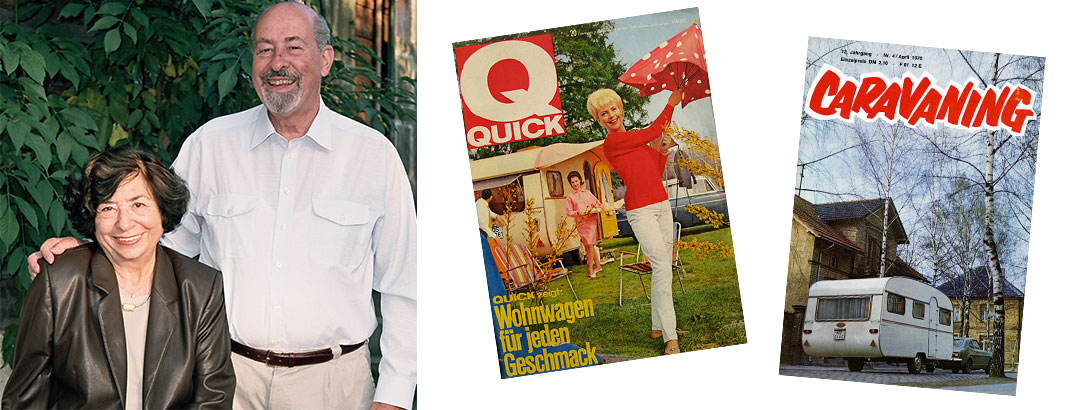
Next year, Eura Mobil will be celebrating its 60th anniversary. To mark the occasion, we conducted an interview with Anneliese and Heinz Blessing about the beginnings of our company. Below is the article that appeared in the Eura Mobil customer journal in January 2019.
Heinz Blessing is the Founder of Blessing Wohnwagenbau GmbH. This nucleus of caravan production in Sprendlingen near Bad Kreuznach gave rise to today's Eura Mobil GmbH emerged. Heinz Blessing managed his company until 1969, when he retired for health reasons. His wife Anneliese also became involved in the family business early on and subsequently became a partner in the successor company Mayr KG, in which the later owner of Eura Mobil GmbH Eugen Immler was also involved. Erwin Hymer was even involved in Mayr KG as a silent partner. We asked Heinz and Anneliese Blessing about the beginnings of Eura Mobil.
Mr Blessing, what prompted you to start building caravans in 1959?
Heinz Blessing: I had always dreamed of travelling with a caravan and got into it as a hobby. I built my first caravan out of plywood in an extension behind our house. Sheet aluminium was not yet available at that time. As a qualified electrical engineer, I worked a lot with technical equipment for cinemas. When demand in the cinema market declined, I turned my hobby of building caravans into a profession, founded Blessing Wohnwagenbau GmbH in 1959 and, together with a carpenter friend, built several caravans at the same time to save costs.
What were the special features of the first Blessing caravans? What set them apart from the competition?
Heinz Blessing: At first, we only built the caravans on a plywood basis, but later we clad them with aluminium sheeting. The windows were important to us, so we installed double windows right from the start. Initially the two-part windows that were also used in the VW bus at the time, later large one-part windows. To distinguish them from the competition, the caravans had a "nose" at the front and rear to allow rainwater to run off.
Anneliese Blessing: I was responsible for the interior design. Upholstery, curtains, decoration. Everything that had to do with colours and fabrics in the interior fell under my remit. In the beginning, we both also worked on production. My husband lent a hand with the painting, for example.
Were there any difficulties that you had to overcome at the beginning?
Heinz Blessing: Firstly, we had to find suitable production space for series production. Things went so well that the production area in the extension behind our building was no longer sufficient. The extension in Friedrich-Ebert Straße also quickly became too small. This was followed by a branch in Pfaffen-Schwabenheim before the new building in Kreuznacher Straße was built in 1965.
Anneliese Blessing: And then we had to change our logo. We had placed a beautiful compass rose in the centre of a triangle and designed it with red colour accents. We and the customers liked that very much. But Mercedes Benz objected to this. The compass rose is a four-pointed star. Because of the four points of the compass. But the Mercedes star is only a three-pointed star. But that didn't help. The first logo had to go.
How did sales develop in the first few years?
Heinz Blessing: I no longer know how many caravans we sold in the first year. In the first two years, it was probably around 200 units per year. We initially found buyers mainly at trade fairs in Essen, the IAA in Frankfurt, the Caravan Salon in Geneva and Lausanne. Later, we added a network of dealers at home and abroad. In 1963, we were featured on the cover of "Quick" [1.7 million copies per week at the time, editor's note]. After that, sales skyrocketed. By the end of the 60s, the company was doing well.
How has the model range developed?
Heinz Blessing: In 1960, we had two models in our range: the Merkur with a body length of 3 metres and the Saturn with a body length of 3.80 metres. These were expanded into model ranges with various layouts. By 1963, we were already offering two Merkur and three Saturn layouts. That made five models in total. By 1965, there were already eight models: the 3-metre-long Mars, two Merkur and three Saturn layouts, and two 4.50-metre-long Jupiter layouts. With 50 employees, including carpenters, upholsterers, painters and bodywork specialists, we were already building 800 caravans a year by the end of the 1960s. The caravans were transported by rail from Sprendlingen station in batches of nine to the dealers.
In 1969, you, Mr Blessing, left the company for health reasons. Mayr KG was founded, in which you, Mrs Blessing, were a partner. Mayr KG then used the brand name Eura Caravan for the first time. Can you explain how the brand name came about?
Anneliese Blessing: Initially, we wanted to register "Europa Carvan", but this was rejected because the company would have too "little significance". The term "Euro" was already protected. So my husband Heinz had the idea of registering Eura Caravan. Since then, Eura has stood for E= recreation, U=holiday, R=travel, A=relaxation.
Thank you for this interview!
Do you always want to be informed about exciting new products from Eura Mobil and do you already drive an Eura Mobil? Then apply for our customer card and you will receive the Eura Mobil Journal twice a year free of charge with the latest news from our company and the industry. Apply for the Eura Mobil Card here!

You are currently viewing a placeholder content from Google Maps. To access the actual content, click the button below. Please note that doing so will share data with third-party providers.
More Information